Amber Gemstone Jewerly
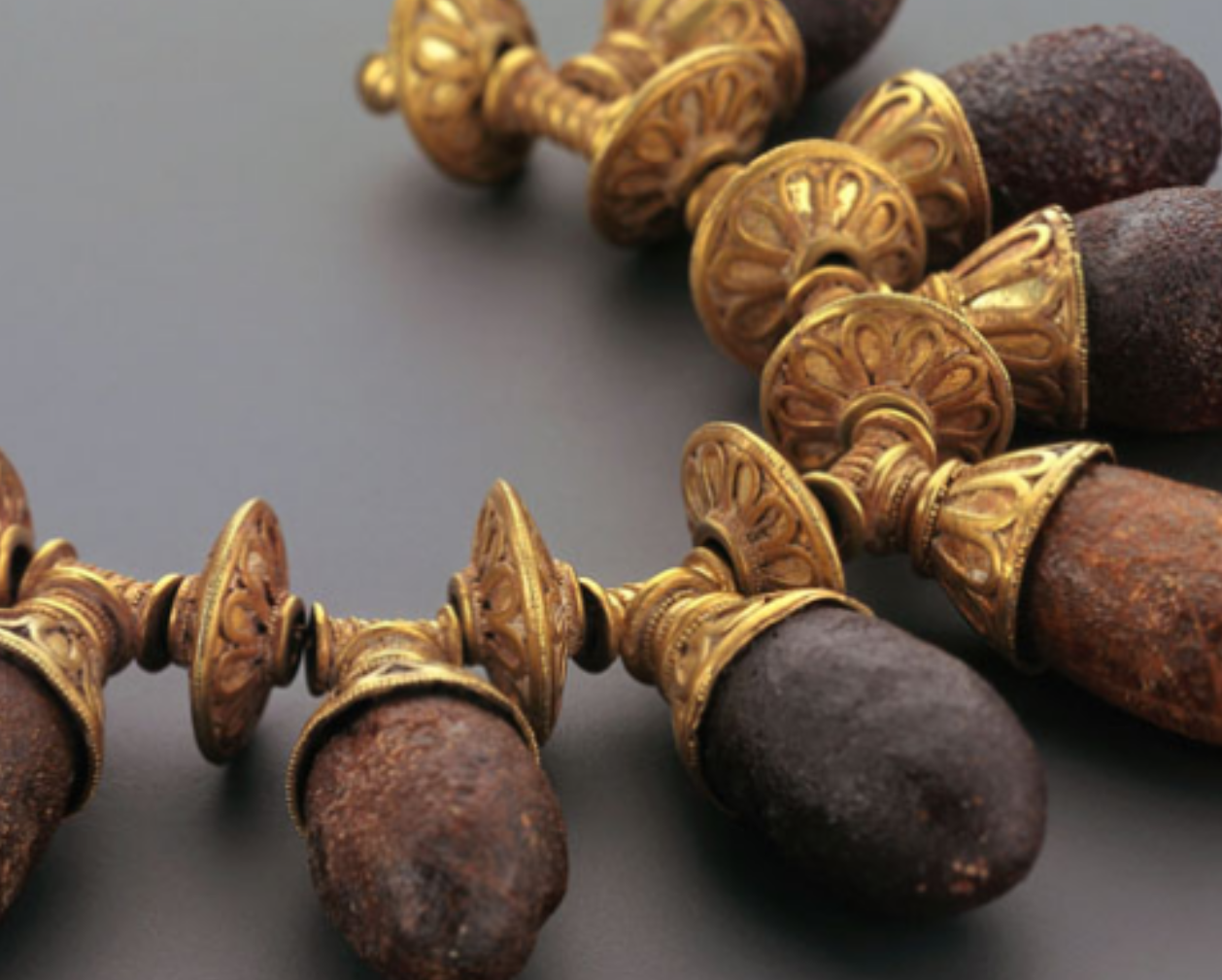 Greek Gold Ancient Amber Necklace c. 6th-4th Century BC
Amber gemstone is said to be one of the oldest gems known to man. Amber is the fossilized, hardened resin of trees, mostly found in conifers. Some amber specimens date back as far as 100 million years, thus allowing scientists to study extinct species in great detail.
Ambragialla - Succinite - Elektron
Different Names For Amber
Ambragialla is an old 16th-century Italian word for the Gem Amber. A less common term for Amber is Succinite. This gem not only delights the eye but uplifts the spirits and some people believe it even offers protection.
Amber's prehistoric origins have caused it to be the source of fascination and intense study. Gemstone meanings and healing lore say that Amber, is physically "protective" and can protect the wearer from electromagnetic radiation (especially x-rays), the sun rays, and even computer radiation! What?! In fact, it's qualities are so special that some Asian people and American Indians, consider Amber to be a sacred healing stone.
In Old Norse mythology, the magical Brisingamen Necklace, was made of Amber and glittered like a constellation in the sky around the goddess, Freyja's neck. The famous Brisingamen necklace made of amber is emblematic of the fruits of the earth.
Together with Moonstone, Natural Pearls, Coral and Jet, Amber is classified as an Organic Gem. It is also classified as an "exotic" in the list of gemstones.
Amber Jewelry from Antiquity to Victorian Amber Jewelry of the 19th Century
Throughout antiquity to the present day Amber has been appreciated. Because its hardness is low on the Mohs Scale of Hardness it rarely survives and is prone to decay. The main source of supply was the Baltic coast. Trade routes brought it to the Mediterranean. Greek and Ancient Egyptian craftsmen used Amber, likewise the Etruscans, until 500 BC, when the supply stopped and the gem went out of fashion. Amber has slowly regained in popularity and was appreciated by the Victorians in the 1890s.
Over 90% of the world's Amber is found in Russia on the Baltic Sea. More than 50 million years ago, there were trees, taller than the redwoods of today, that grew along the shores of the Baltic Sea. As a result of glaciers, the trees were swept into the sea and there they solidified under ice and pressure. And it's in this resin from these trees where the amber is found. Amber is also found washed up on the seashore, because its relative density is such that it floats on saltwater.
Ambragialla or Amber may include inclusions of insects, petals of flowers, seeds, and bark that have been locked inside for thousands and even millions of years. Included material increases the value of Amber. Intact frogs, lizards, snake skins, bird feathers, the hair and bones of mammals, various plant materials and insects have all been better preserved than any royal tomb thanks to Amber. Genetic scientists are interested in this stone for the possibility of DNA sampling.
There have been ancient specimens of fossilized amber, in which DNA has been extracted from the fossilized organisms and then compared with that of its modern-day counterparts!
Amber is not a mineral but an organic stone and until the mid 19th century, most amber, was also known as "seastone" and was picked up along the seashore. From the mid 19th century, dredging operations began along the shores of the Baltic, and mining, often open-pit, started in the late 19th century.
There is no such thing as sustainable Gold mining or sustainable amber mining. Gold mining, by which jewellers obtain the bulk of their raw materials is unsustainable.
Once a gemstone or mineral has been removed from the earth, it can't return. They can talk all they like about "sustainable mining methods" that ah..protect the environment?!
Over the past century more than 100 million tons of waste have been discharged into the Baltic Sea from the Palmnicken (Yantarny) mine. The insoluble toxic waste product causes high turbidity appearing as thick, cloudy matter covering the surface of the Baltic Sea which threatens the survival of precious Amber Gemstone.
It's like the term, 'sustainable economic opportunities' created by slick marketing campaigns. When it comes to natural gems and minerals we cannot truthfully talk about a sustainable product with the exception of - Antique Jewelry that doesn't cost the earth.
The Colors of Amber Gemstone
What determines the color of Amber? The color of Amber depends on the depth of the water into which the tree, the source of Amber originally fell, possibly millions of years ago. Normally it is a golden yellow or light-yellow to honey color but can be all shades in between including brown and red-brown hues, the latter of which are known as Cherry Ambers. The more interesting pieces of Amber contain a mixture of shades. Amber gemstone can be translucent, opaque or a mix of both.
The strange quality of Amber lies in its weight. Genuine Amber looks a lot heavier than it really is. When you hold genuine Amber in your hand, you will be surprised how light it feels - a large, chunky Amber necklace can be worn with ease and comfort. That's one of Amber gemstone's special qualities. Amber floats of salt water.
Amber Gemstone Imitation
There's an abundant supply of counterfeit amber in the market-place despite that it's quite easy to spot an imposter. Time-saving tips on how to identify Genuine Amber can be found Here...
Imitation Amber that even includes inclusions has been produced for at least 600 years. Fresh resins, synthetic polystyrenes, bakelite, epoxy resins, celluloid, colored glass, plastics, and polyesters have all been used to make imitation Amber.
Identify Genuine Amber Gemstone from Fake Amber by:
- weight
- hardness
- melting temperature
- lack of solubility
- fluorescence
- specific gravity
- refractive index (a measure of the degree that it bends light)
- smell - and odor on burning
- Rubbing amber with a cloth will generate static electricity, causing the paper to stick to it. This property has been recognized since ancient times, and the word ‘electricity’ derives from the ancient Greek word for amber, elektron, meaning sun-made.
Caring for Amber
Amber is a soft mineral on the Mohs Scale and prone to decay. To preserve the life of Amber care for this gemstone, in the same way, you would care for Pearls...
Protect Amber, Pearls, Jade gemstone and Opal Gemstone Jewelry from perfume and hairspray. A bath of warm water and gentle detergent is all that's needed to clean your Amber gemstone jewelry.
Purchase Amber Jewelry from a trusted source. A good book on Amber will increase your knowledge of the subject and add to the pleasure you experience when wearing and investing in Amber Gemstone Jewelry.
Reference: Cotterell, A., 1996, Classical Mythology, Lorenz Books, London.
Image: https://archaicwonder.tumblr.com
Return to the top of Amber Gemstone
Return to Gemstone Meanings
Return to Atique Jewelry Investor Home Page
